UNDERSTORY DORRIGO · UNDERSTORIES · A TALE
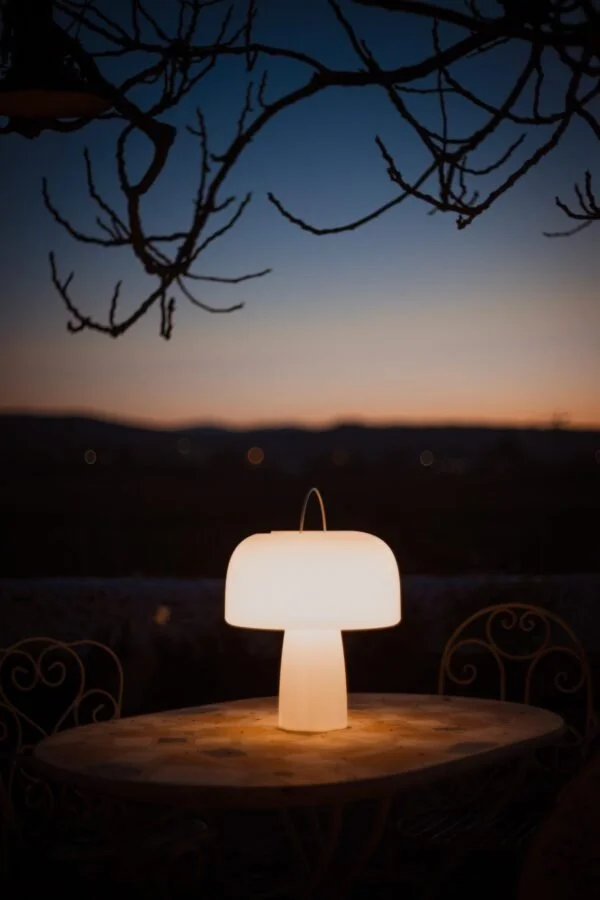
The Lamp That Drank the Sun
A tale, truthfully told — of the Boleti Lamp, made by Goodnight Light of Barcelona
✦
I
In olden times, when the rain had passed and the woods stood dripping, there rose from the leaf-litter a mushroom with a fat stalk and a round brown cap — standing there by morning where nothing had been the night before. In our own green hinterland of Dorrigo, sitting atop the mountain, such mushrooms still rise after the rain, domed and improbable, and are gone again within a handful of days. Of all the shapes the forest makes, this one is among the oldest, and the most fondly known.
II
This mushroom was so beloved that every land it grew in gave it a name of its own. The Italians called it the little pig; the French named it for the stout trunk of its stem; the Germans called it the stone-mushroom; and the Dutch, fancifully, the squirrel’s bread. The English, plainest of all, called it the penny bun, for a ripe one looks like a glazed brown roll fresh from the baker’s oven. Its older name, handed down by scholars, means no more than a ‘lump of the earth’.
III
The old folk found a use for every part of it. They dried its cap through the winter and kept it for aching backs and stiff sinews — or so they believed — and from the spongy underside they drew a dye that turned wool to soft brown and gold hues. They said the surest night to seek it was beneath a full moon; that it sprang up where lightning had struck the ground, or where the fair folk had been dancing in their rings. A humble thing, and yet wonder, awe and folklore trailed behind it.
IV
Now it happened that, far away in the city of Barcelona in Spain, there lived a husband and his wife, Eva and Marke Newton, who designed lamps with their own hands. They had not forgotten the mushrooms of the woods, nor the round-capped lamps that had glowed in their grandparents’ parlours in the years of the nineteen-sixties and seventies. And they said, one to the other: let us make a lamp in that old shape. And so they did, and called it Boleti, after the mushroom itself.
V
The lamp they made was a domed cap upon a steady, weighted foot, with a slender handle that folds up from its crown, so that it might be carried through the dusk like a little lantern. They moulded its body from a single honest stuff that will not shatter should it fall, nor crack and pale in the sun, nor take any harm from the rain — and which may, at the very end of its long life, be melted down and made anew.
VI
And here is the wonder of it, which is no magic at all. By day the lamp drinks the sunlight through a small dark panel set in the top of its cap and stores it away. As dark falls a faithful watchman within wakes of its own accord, and the lamp gives back a warm and gentle light — nearer to candle-flame than to any cold glass bulb — for five or six hours. It needs no cord, and no thread tying it to the wall.
VII
There is a quiet lesson in such a lamp. So much of what lights our homes is made nowhere in particular, bound to the wall, or thrown out when the season turns. This one is the opposite in every part: shaped by hands whose names you may know, made in a single place, fed by nothing but the sun, and built to be kept for years and handed on. Lift its drinking-heart out, set it in the light, and it begins again.
VIII
So, when the evening comes, and you set it on the garden table or the windowsill, remember what it is. A mushroom, after all, is only sunlight and rain gathered up into a shape. And so, it turns out, is a good lamp. There it sits, drinking the day and giving light in the dark; and if it is cared for, it may sit for many years to come.
✦